Download this free A1–A2 grammar worksheet PDF for English learners and teachers. This lesson helps students practise adverbs of frequency and present simple word order.
Students learn how to use adverbs of frequency to say how often something happens. The worksheet teaches common frequency adverbs such as always, usually, often, sometimes, hardly ever and never.
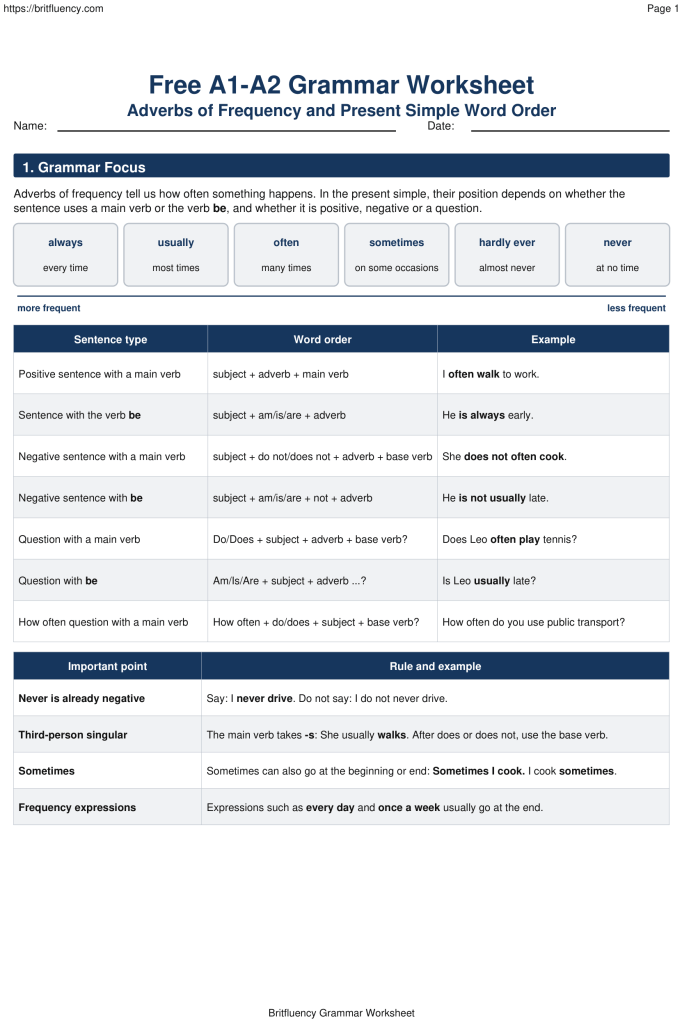
The worksheet explains where adverbs of frequency go in present simple sentences. Students practise the standard word order with main verbs, such as I often walk to work, Mia usually walks to work and They never drive to work.
Students also practise word order with the verb be. The worksheet shows that the adverb usually goes after am, is or are, as in He is always early, Sara is often tired and We are always ready.
The worksheet also teaches adverbs of frequency in negatives and questions. Students learn forms such as She does not often cook, He is not usually late, Does Leo often play tennis?, Is Leo usually late? and How often do you use public transport?
The PDF includes a grammar focus section, adverbs of frequency exercises, choose-the-correct-form practice, sentence matching, mistake correction, mini-dialogues, word order rewriting, meaning-and-use practice, speaking practice, writing practice, vocabulary and grammar sentence practice, an error-checking challenge, useful reminders and a full answer key.
This worksheet can be used in one-to-one lessons, group classes, online English lessons, adult ESL lessons, EFL classes, homework or independent grammar practice.
Level: A1–A2
Grammar point: Adverbs of frequency and present simple word order
Focus: grammar accuracy, always, usually, often, sometimes, hardly ever, never, present simple, word order, speaking and writing
Format: Free grammar worksheet PDF with answer key
This free worksheet includes:
- a clear explanation of adverbs of frequency
- practice with always
- practice with usually
- practice with often
- practice with sometimes
- practice with hardly ever
- practice with never
- practice with present simple word order
- practice with adverbs before main verbs
- practice with adverbs after the verb be
- practice with negative sentences
- practice with present simple questions
- practice with How often…? questions
- practice avoiding double negatives with never
- practice using the base verb after does and does not
- choose-the-correct-form practice
- sentence-to-reason matching
- mistake correction
- mini-dialogues
- sentence rewriting
- meaning-and-use practice
- speaking practice
- writing practice
- vocabulary and grammar sentence practice
- an error-checking challenge
- useful reminder table
- full answer key for teachers and students
The worksheet focuses especially on common A1–A2 mistakes such as I am always go, She usually walk, He often tired, We do not never eat, Does Mia usually works?, They often goes, I always drinking and Are you often work? The main classroom point is simple: put frequency adverbs before main verbs, after the verb be, use never without not, and use the base verb after does or does not.
Preview the worksheet below. To read the full worksheet clearly or open the PDF, use the button below the preview image.
Worksheet preview
More free English worksheets from Britfluency
A2–B2 English Worksheets
B2–C2 English Worksheets
IELTS Practice Materials
Grammar Practice Worksheets
