Download this free A2–B1 English worksheet PDF for English learners and teachers. This lesson is based on a recent Guardian article about whether people really need to eat breakfast, lunch and dinner every day.
Students practise reading comprehension, useful vocabulary and speaking skills through a real-world topic about food routines, breakfast, snacks, modern life, family meals and flexible eating. The worksheet is suitable for private English lessons, online classes, classroom teaching, homework and self-study.
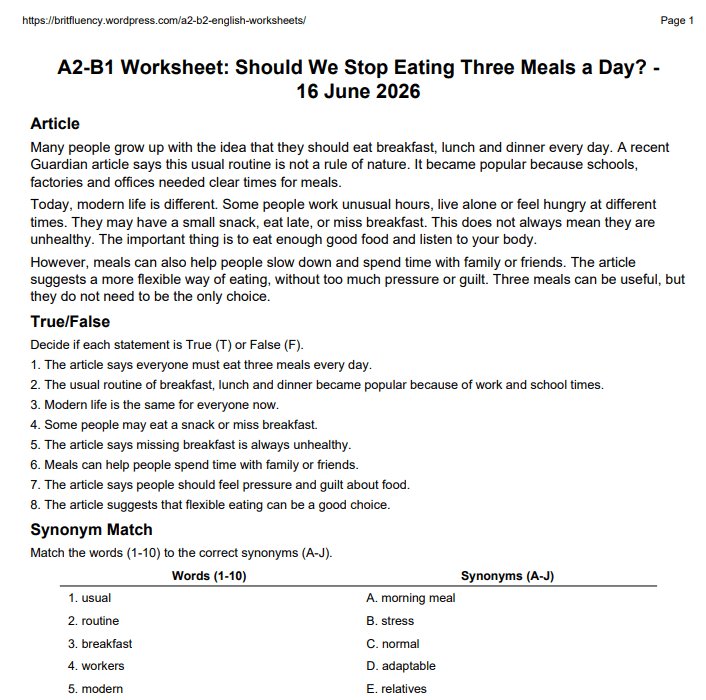
The article explains the topic in clear, simple English. Students read that the usual routine of breakfast, lunch and dinner became popular because schools, factories and offices needed clear times for meals. The text also explains that modern life is different now, and some people work unusual hours, live alone or feel hungry at different times.
This worksheet helps lower-level learners talk about daily routines, food habits and health using accessible language. Students discuss whether they usually eat breakfast, whether snacks can be healthy, whether work hours control how people eat and whether a more flexible eating routine would suit modern life better.
The PDF includes a short A2–B1 reading text, True / False questions, Synonym Match, a task where students use new vocabulary, discussion questions and a full answer key. It helps learners build useful vocabulary for talking about meals, snacks, family, pressure, healthy eating and everyday routines.
Level: A2–B1
Date: 16 June 2026
Focus: reading, vocabulary, food routines, health, modern life and speaking
This free worksheet includes:
- an A2–B1 reading text about eating three meals a day
- True / False comprehension questions
- Synonym Match vocabulary practice
- a sentence-writing task using new language
- discussion questions for Student A and Student B
- full answer key
The worksheet practises useful vocabulary such as usual, routine, breakfast, workers, modern, snack, flexible, healthy, family and pressure. It helps students discuss breakfast, snacks, eating alone, family meals, food guilt, work schedules and whether three meals a day should be the only normal routine.
Worksheet preview
A2–B2 English Worksheets
B2–C2 English Worksheets
IELTS Practice Materials
Free English Grammar Worksheets PDF
