Download this free B1–B2 English worksheet PDF for English learners and teachers. This lesson explores body language, first impressions and the danger of judging people too quickly.
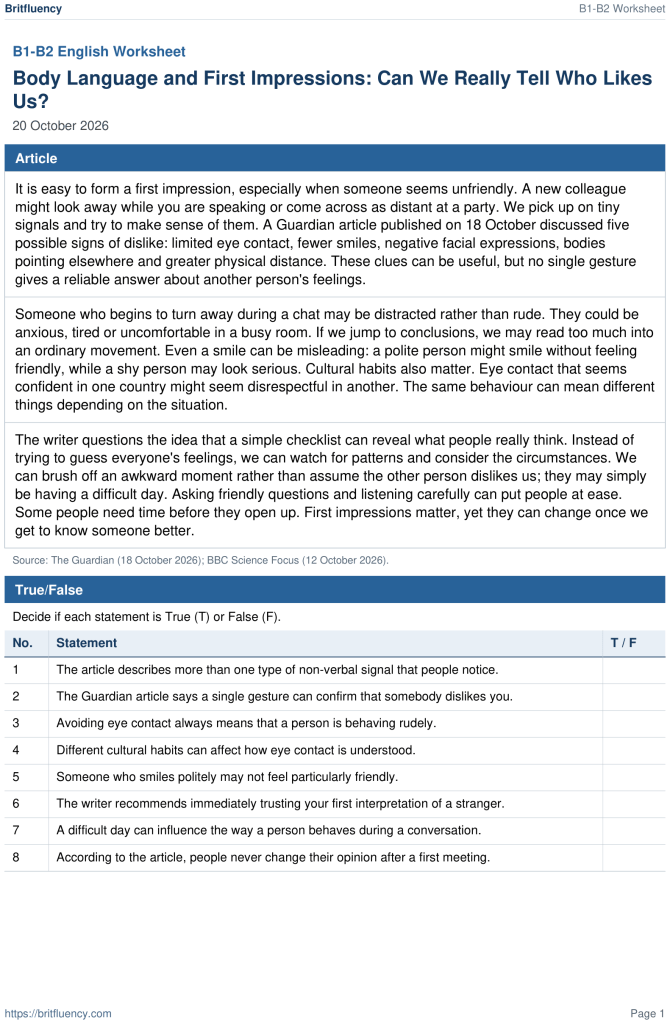
The article looks at common non-verbal signals people notice when meeting someone, including eye contact, smiling, facial expressions, body position and physical distance. It explains that these signals can be useful, but that no single gesture gives a reliable answer about how another person really feels.
Students consider how easy it is to jump to conclusions. Someone who looks away may be tired, anxious or distracted rather than rude, while a polite smile does not necessarily mean that someone feels friendly. The same behaviour can also have different meanings in different cultures.
The worksheet also questions whether simple body-language checklists can really tell us what another person is thinking. Instead, students are encouraged to consider the situation, look for patterns and avoid reading too much into one awkward moment.
The discussion section gives students opportunities to talk about first impressions, eye contact, facial expressions, cultural differences, job interviews, confidence and whether people should trust their instincts or wait for more evidence.
Level: B1–B2
Date: 20 October 2026
Focus: Reading comprehension, phrases, vocabulary and discussion about body language, first impressions and social judgement
This free worksheet includes:
- A three-paragraph reading article about body language and first impressions
- Eight True/False reading-comprehension questions
- A Phrase Match activity with 10 useful expressions
- A Synonym Match exercise with 10 vocabulary items
- A Use the New Language activity in which students write their own sentences
- 16 discussion questions divided between Student A and Student B
- Speaking topics including eye contact, first impressions, cultural differences, interviews and social misunderstandings
- A complete answer key
- Example sentences showing how the target phrases can be used naturally
Useful phrases from the worksheet include look away, come across as, pick up on, make sense of, turn away, jump to conclusions, read too much into, brush off, put people at ease and open up. Students also practise vocabulary such as distant, tiny, gesture, reliable, distracted, anxious, confident, misleading, awkward and circumstances.
A useful classroom focus is the idea that body language should always be interpreted in context. The worksheet encourages students to think about alternative explanations before deciding what another person’s behaviour means.
More free English resources from Britfluency:
A2–B2 English Worksheets
B2–C2 English Worksheets
IELTS Practice Materials
Free English Grammar Worksheets PDF
