Download this free B1–B2 grammar worksheet PDF for English learners and teachers. This lesson helps students practise modal verbs in English, including must, have to, mustn’t, don’t have to, should, can and could.
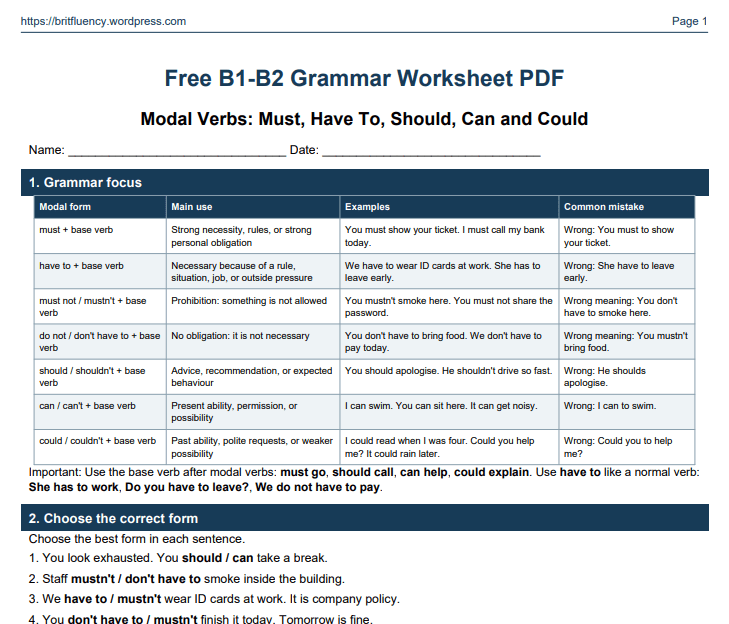
Students learn how to use must + base verb for strong necessity, rules and strong personal obligation. The worksheet includes examples such as You must show your ticket and I must call my bank today, while also helping students avoid common mistakes such as must to show.
The worksheet also teaches the difference between must, have to, mustn’t and don’t have to. Students practise have to for external necessity, such as rules, jobs or situations, and they learn the important difference between mustn’t for prohibition and don’t have to for no obligation. This is a key B1–B2 grammar contrast because You mustn’t bring food and You don’t have to bring food have very different meanings.
Students also practise should / shouldn’t for advice, can / can’t for present ability, permission and possibility, and could / couldn’t for past ability, polite requests and weaker possibility. The worksheet gives clear examples such as You should apologise, I can swim, Could you help me? and I couldn’t drive when I was sixteen.
The PDF includes a grammar focus section, modal verbs exercises, choose-the-correct-form practice, sentence matching, mistake correction, mini-dialogues, rewriting tasks, meaning-and-use practice, speaking questions, writing practice, vocabulary and grammar sentence practice, an error-checking challenge, useful reminders and a full answer key.
This worksheet can be used in one-to-one lessons, group classes, online English lessons, adult ESL lessons, EFL classes, homework or independent grammar practice.
Level: B1–B2
Grammar point: Modal verbs: must, have to, should, can and could
Focus: grammar accuracy, rules, obligation, prohibition, advice, ability, permission, polite requests, speaking and writing
Format: Free grammar worksheet PDF with answer key
This free worksheet includes:
- a clear explanation of must, have to, should, can and could
- practice with must + base verb
- practice with have to + base verb
- practice with mustn’t / must not for prohibition
- practice with don’t have to for no obligation
- practice with should / shouldn’t for advice
- practice with can / can’t for present ability, permission and possibility
- practice with could / couldn’t for past ability and polite requests
- choose-the-correct-form practice
- sentence-to-reason matching
- mistake correction
- mini-dialogues
- rewriting tasks
- meaning-and-use practice
- speaking practice
- writing practice
- vocabulary and grammar sentence practice
- an error-checking challenge
- useful reminder section
- full answer key for teachers and students
The worksheet focuses especially on common B1–B2 mistakes such as must to wear, she do not have to, must not to park, can to help, could you passing, shoulds, have leave and could not drove. The main classroom point is simple: after must, should, can and could, use the base verb without to; use have to like a normal verb; and remember that mustn’t means something is forbidden, while don’t have to means something is not necessary.
Preview the worksheet below. To read the full worksheet clearly or open the PDF, use the button below the preview image.
Worksheet preview
More free English worksheets from Britfluency
A2–B2 English Worksheets
B2–C2 English Worksheets
IELTS Practice Materials
Grammar Practice Worksheets
