Download this free C1–C2 English worksheet PDF for English learners and teachers. This advanced lesson examines body language, first impressions and how confidently we should interpret other people’s behaviour.
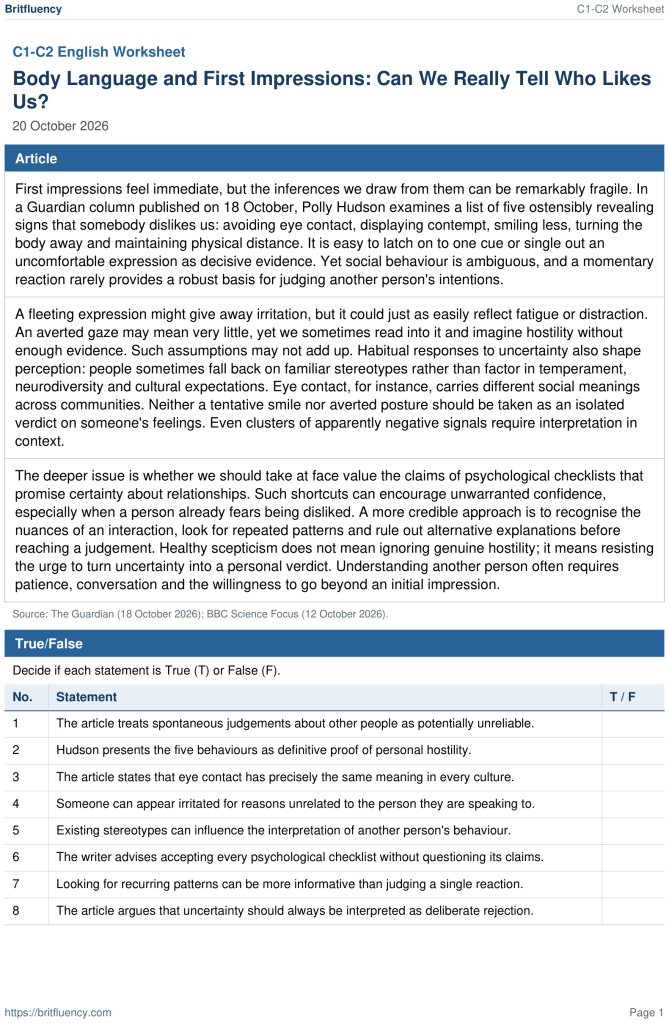
The article considers five commonly cited signs that somebody may dislike us: avoiding eye contact, showing contempt, smiling less, turning the body away and maintaining physical distance. It questions whether these signals really provide strong evidence about another person’s intentions.
Students explore why social behaviour is often ambiguous. A fleeting expression may suggest irritation, but it could equally reflect tiredness or distraction. An averted gaze may be interpreted as hostility even when there is little evidence to support that conclusion.
The worksheet also examines how stereotypes, temperament, neurodiversity and cultural expectations can affect interpretation. Eye contact, for example, may carry very different meanings across cultures, so body-language signals cannot always be treated as universal.
The article goes further by questioning psychological checklists that promise certainty about relationships. Students consider why it may be more reliable to look for repeated patterns, rule out alternative explanations and avoid taking isolated gestures at face value.
The discussion section develops this into broader questions about stereotyping, neurodiversity, job interviews, cultural norms, confidence and the popularity of simplified psychological advice.
Level: C1–C2
Date: 20 October 2026
Focus: Advanced reading comprehension, idiomatic phrases, vocabulary and discussion about body language, interpretation, culture and psychological assumptions
This free worksheet includes:
- An advanced three-paragraph article about body language, first impressions and social interpretation
- Eight True/False questions testing detailed reading comprehension
- A Phrase Match activity with 10 advanced expressions
- A Synonym Match exercise with 10 precise vocabulary items
- A Use the New Language activity requiring students to produce their own sentences
- 16 advanced discussion questions divided between personal experience and deeper discussion
- Speaking topics including stereotypes, neurodiversity, cultural norms, job interviews and psychological checklists
- A complete answer key
- Example sentences demonstrating the target phrases in natural contexts
Useful phrases from the worksheet include latch on to, single out, give away, read into, add up, fall back on, factor in, take at face value, rule out and go beyond. Advanced vocabulary includes inferences, fragile, ostensibly, contempt, ambiguous, robust, habitual, tentative, unwarranted and nuances.
A central classroom point is that first impressions can feel convincing while still being unreliable. The worksheet encourages students to examine how uncertainty, stereotypes and cultural expectations shape interpretation and why careful judgement often requires more than one observable signal. extraordinary goal can create a new psychological challenge of its own.
Worksheet preview
More free English resources from Britfluency:
B2–C2 English Worksheets
A2–B2 English Worksheets
IELTS Practice Materials
Free English Grammar Worksheets PDF
