Download this free C1–C2 English worksheet PDF for English learners and teachers. This advanced lesson examines embryo screening, polygenic scores, reproductive autonomy and the ethical debate surrounding so-called designer babies.
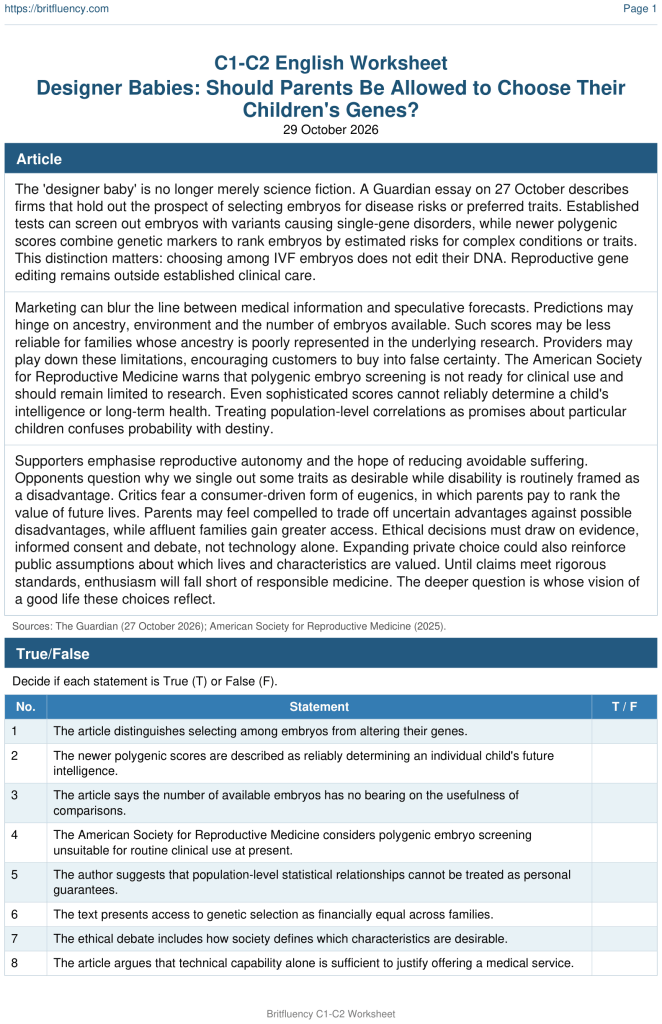
The article describes an online experiment conducted by researchers at the University of Amsterdam with 750 American adults. Participants had to The article distinguishes established tests for certain single-gene disorders from newer polygenic screening. These newer scores combine genetic markers to rank embryos according to estimated risks for complex conditions or traits, but choosing among embryos does not alter their DNA.
Students examine why the apparent precision of genetic predictions can be misleading. Results may depend on ancestry, environment and the number of embryos available, while some groups may be less accurately represented in the underlying research.
The worksheet also considers the role of marketing. Providers may play down limitations or encourage customers to buy into claims that sound more certain than the science actually allows. The article stresses that sophisticated statistical scores cannot reliably determine an individual child’s future intelligence or long-term health.
The ethical debate then becomes broader. Supporters emphasise reproductive autonomy and the possibility of reducing avoidable suffering, while critics question why society singles out certain traits as desirable and fear a consumer-driven form of eugenics.
Students also consider inequality. Affluent families may gain greater access to expensive technologies, while expanding private choice could reinforce assumptions about which lives and characteristics society values most highly.
The discussion section asks students to consider disability, social pressure, regulation, evidence, reproductive freedom and the distinction between reducing disease risk and attempting to optimise future children.
Level: C1–C2
Date: 29 October 2026
Focus: Advanced reading comprehension, idiomatic phrases, vocabulary and discussion about genetics, reproductive autonomy and bioethics
This free worksheet includes:
- An advanced three-paragraph article about designer babies, embryo screening and polygenic prediction
- Eight True/False questions testing detailed reading comprehension
- A Phrase Match activity with 10 advanced expressions
- A Synonym Match exercise with 10 precise vocabulary items
- A Use the New Language activity requiring students to write their own sentences
- 16 advanced discussion questions divided between personal experience and deeper discussion
- Speaking topics including reproductive autonomy, disability, inequality, regulation and medical evidence
- A complete answer key
- Example sentences demonstrating the target phrases in natural contexts
Useful phrases from the worksheet include hold out, screen out, blur the line, hinge on, play down, buy into, single out, trade off, draw on and fall short of. Advanced vocabulary includes prospect, distinction, speculative, ancestry, limitations, autonomy, avoidable, compelled, affluent and routinely.
A central classroom point is the difference between scientific capability and responsible clinical use. The worksheet encourages students to question how much weight should be given to uncertain predictions, how technology may reinforce inequality and whose idea of a “good life” is reflected in decisions about future children.
Worksheet preview
More free English resources from Britfluency:
B2–C2 English Worksheets
A2–B2 English Worksheets
IELTS Practice Materials
Free English Grammar Worksheets PDF
English Listening Exercises
