Download this free C1–C2 English worksheet PDF for advanced English learners and teachers. This lesson explores dynamic pricing, personalised pricing, algorithmic decision-making and the growing debate about transparency, consent and consumer data.
Students practise advanced reading comprehension, high-level vocabulary, phrase matching and speaking skills through a real-world business, technology and consumer-rights topic about variable prices, artificial intelligence, personal data, market power and information asymmetry. The worksheet is suitable for advanced conversation lessons, online English classes, private tutoring, IELTS-style speaking practice and critical thinking work.
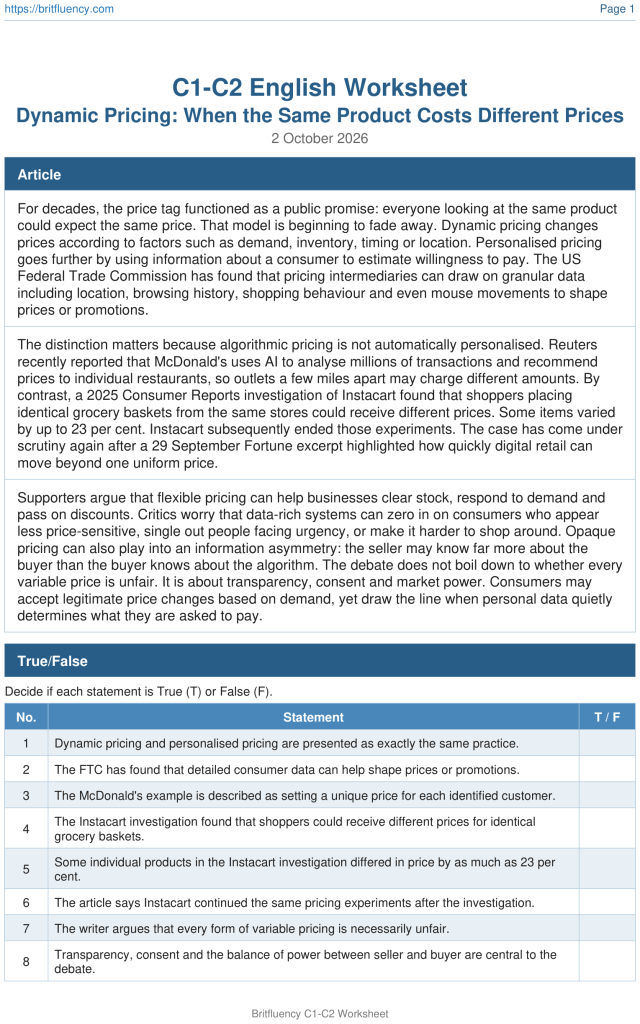
The article explains the distinction between dynamic and personalised pricing. Dynamic pricing changes according to factors such as demand, inventory, timing or location, while personalised pricing can use information about an individual consumer to estimate willingness to pay.
Students read that the US Federal Trade Commission has found that pricing intermediaries can draw on detailed information including location, browsing history, shopping behaviour and even mouse movements. The worksheet also examines examples involving McDonald’s and Instacart, showing why algorithmic pricing is not necessarily the same as personalised pricing.
This worksheet encourages advanced learners to discuss whether flexible pricing is efficient or potentially exploitative. Students consider whether companies should be allowed to zero in on customers who appear less price-sensitive, whether urgent buyers can be unfairly singled out and whether opaque pricing makes it harder for consumers to shop around effectively.
The article also explores the wider issue of information asymmetry. Sellers may know far more about consumers than consumers know about the algorithms setting their prices. The lesson asks where people should draw the line between legitimate price changes based on demand and prices quietly shaped by personal data.
The PDF includes a C1–C2 reading article, True / False questions, Phrase Match, Synonym Match, a task where students use new language, discussion questions and a full answer key. It helps learners discuss market power, transparency, consent, algorithmic pricing, tailored discounts, consumer choice and digital retail.
Level: C1–C2
Date: 2 October 2026
Focus: advanced reading, vocabulary, dynamic pricing, personalised pricing, algorithms, consumer data and speaking
This free worksheet includes:
- a C1–C2 reading article about dynamic and personalised pricing
- True / False comprehension questions
- Phrase Match practice with advanced expressions
- Synonym Match with high-level vocabulary
- a sentence-writing task using new language
- discussion questions for Student A and Student B
- full answer key
The worksheet includes useful advanced phrases such as fade away, draw on, come under scrutiny, pass on, zero in on, single out, shop around, play into, boil down to and draw the line. It also practises vocabulary such as uniform, granular, opaque, personalised, legitimate, variable, transparency, consent, asymmetry and subsequently.emature, deliberate, tolerance, uncertainty, unresolved and magnify.
Worksheet preview
More free English resources from Britfluency:
B2–C2 English Worksheets
A2–B2 English Worksheets
IELTS Practice Materials
Free English Grammar Worksheets PDF
