Download this free C1–C2 English worksheet PDF for English learners and teachers. This advanced lesson examines NASA’s 378-day CHAPEA Mars isolation experiment, communication delays, psychological pressure and the demands of long-duration space missions.
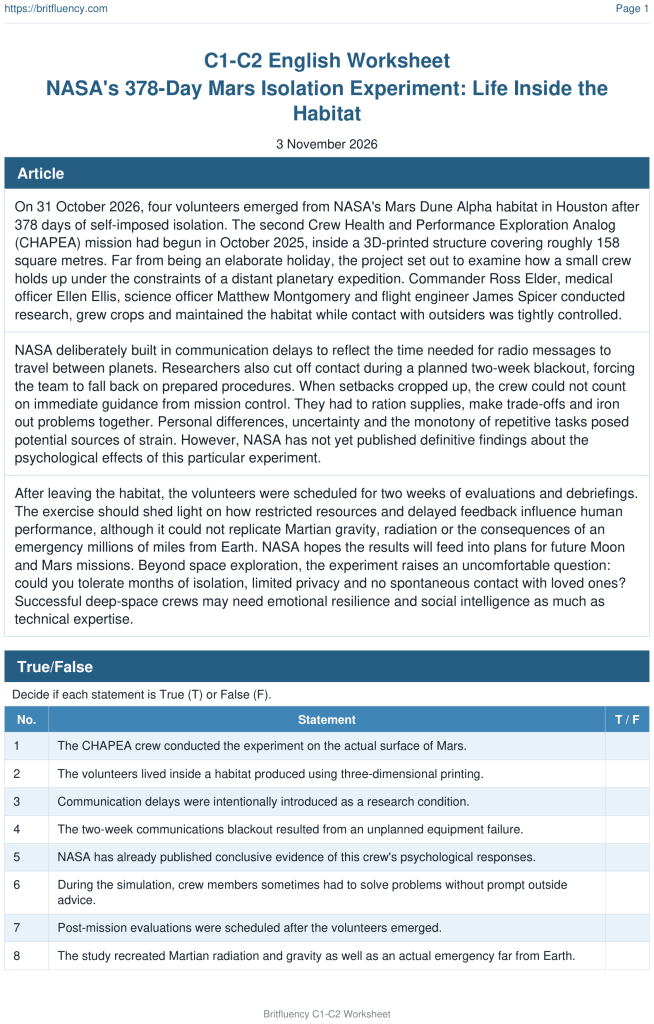
The article describes how four volunteers emerged from NASA’s Mars Dune Alpha habitat in Houston on 31 October 2026 after 378 days of self-imposed isolation. The mission took place inside a 3D-printed structure covering roughly 158 square metres and was designed to examine how a small crew holds up under the conditions of a distant planetary expedition.
Students read about the practical challenges built into the simulation. NASA deliberately introduced communication delays to imitate the time required for radio messages to travel between planets, and researchers also cut off contact during a planned two-week blackout.
When setbacks cropped up, the crew could not always count on immediate guidance from mission control. They had to ration supplies, make trade-offs, fall back on established procedures and iron out problems together.
The article also considers the psychological demands of long-term confinement. Repetitive tasks, limited privacy, uncertainty and personal differences could all create strain, although NASA had not yet published definitive findings about the psychological effects of this particular mission.
After leaving the habitat, the volunteers were scheduled for around two weeks of evaluations and debriefings. The experiment may shed light on how delayed feedback and restricted resources influence human performance, while also helping to feed into planning for future Moon and Mars missions.
The worksheet also stresses the limits of an Earth-based simulation. It could not reproduce Martian gravity, radiation or the consequences of a genuine emergency millions of miles from Earth.
Level: C1–C2
Date: 3 November 2026
Focus: Advanced reading comprehension, idiomatic phrases, vocabulary and discussion about isolation, resilience and long-duration space missions
This free worksheet includes:
- An advanced three-paragraph article about NASA’s CHAPEA Mars isolation experiment
- Eight True/False questions testing detailed reading comprehension
- A Phrase Match activity with 10 advanced expressions
- A Synonym Match exercise with 10 precise vocabulary items
- A Use the New Language activity requiring students to produce their own sentences
- 16 advanced discussion questions divided between Student A and Student B
- Speaking topics including confinement, communication delays, privacy, ethics, resilience and Mars exploration
- A complete answer key
- Example sentences demonstrating the target phrases in natural contexts
Useful phrases from the worksheet include set out to, hold up under, build in, cut off, fall back on, crop up, count on, iron out, shed light on and feed into. Advanced vocabulary includes constraints, deliberately, setbacks, monotony, definitive, replicate, spontaneous, expertise, potential and restricted.
A central classroom point is whether realistic Mars simulations can truly predict human behaviour on an actual interplanetary mission. The worksheet encourages students to discuss emotional resilience, technical expertise, decision-making, privacy and the ethical limits of deliberately creating stress and isolation.
Worksheet preview
More free English resources from Britfluency:
B2–C2 English Worksheets
A2–B2 English Worksheets
IELTS Practice Materials
Free English Grammar Worksheets PDF
English Listening Exercises
