Download this free C1–C2 English worksheet PDF for advanced English learners and teachers. This lesson explores procrastination, emotional regulation, academic performance and why delaying a task can become a self-reinforcing behavioural cycle.
Students practise advanced reading comprehension, high-level vocabulary, phrase matching and speaking skills through a real-world psychology, education and productivity topic about procrastination, perfectionism, emotional avoidance, accountability and behavioural change. The worksheet is suitable for advanced conversation lessons, online English classes, private tutoring, IELTS-style speaking practice and critical thinking work.
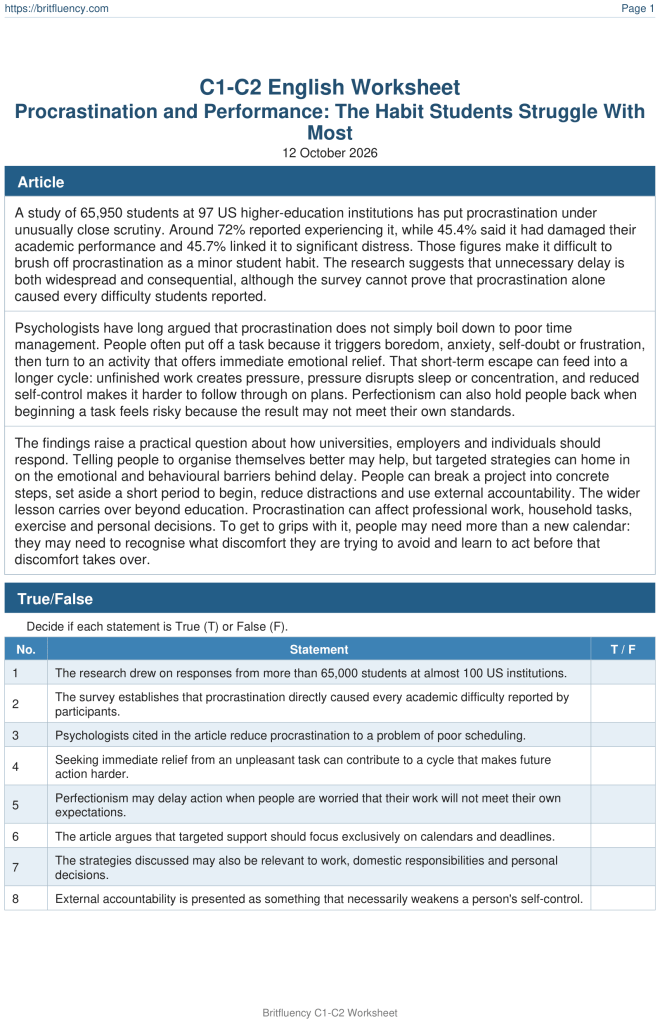
The article draws on a study of 65,950 students at 97 US higher-education institutions. Around 72% reported experiencing procrastination, while 45.4% said it had damaged their academic performance and 45.7% linked it to significant distress.
The worksheet makes an important distinction between association and causation. The findings show that procrastination is widespread and consequential, but the survey does not prove that procrastination alone caused every academic difficulty reported by students.
Students also explore the argument that procrastination does not simply boil down to poor time management. A difficult task may trigger boredom, anxiety, self-doubt or frustration, causing someone to turn to an easier activity that provides immediate emotional relief.
The article examines how this short-term escape can feed into a longer cycle. Unfinished work creates pressure, pressure may disrupt sleep or concentration, and reduced self-control can make it harder to follow through on plans. Perfectionism can also hold people back when beginning a task feels risky because the final result may not meet their own standards.
The lesson then considers more targeted responses. Students discuss breaking projects into concrete steps, setting aside a short period simply to begin, reducing distractions and using external accountability. The wider question is whether people need to understand the discomfort behind procrastination rather than relying only on calendars and time-management advice.
This worksheet helps C1–C2 learners discuss procrastination critically. Students consider whether it is primarily a personal responsibility or partly shaped by digital environments, whether productivity apps can become another form of avoidance, how perfectionism feeds into delay, and where the line lies between legitimate rest and harmful avoidance.
The PDF includes a C1–C2 reading article, True / False questions, Phrase Match, Synonym Match, a task where students use new language, discussion questions and a full answer key.
Level: C1–C2
Date: 12 October 2026
Focus: advanced reading, vocabulary, procrastination, emotional regulation, perfectionism, accountability and speaking
This free worksheet includes:
- a C1–C2 reading article about procrastination and performance
- discussion of the difference between procrastination and poor time management
- exploration of emotional avoidance, perfectionism and self-control
- practical strategies for reducing procrastination
- True / False comprehension questions
- Phrase Match practice with advanced expressions
- Synonym Match with high-level vocabulary
- a sentence-writing task using new language
- discussion questions for Student A and Student B
- full answer key
The worksheet includes useful advanced phrases such as brush off, boil down to, put off, turn to, feed into, follow through on, hold people back, home in on, set aside and get to grips with. It also practises vocabulary such as scrutiny, consequential, frustration, immediate, disrupts, targeted, barriers, concrete, accountability and discomfort.
Worksheet preview
More free English resources from Britfluency:
B2–C2 English Worksheets
A2–B2 English Worksheets
IELTS Practice Materials
Free English Grammar Worksheets PDF
