Download this free C1–C2 English worksheet PDF for advanced English learners and teachers. This lesson explores the enduring “lizard brain” metaphor, the history of the triune brain model and why modern comparative neuroscience rejects a simple evolutionary ladder from reptilian instinct to human rationality.
Students practise advanced reading comprehension, high-level vocabulary, phrase matching and speaking skills through a real-world neuroscience, psychology and critical-thinking topic about scientific models, evidence, oversimplification, AI-generated information and how entrenched myths survive. The worksheet is suitable for advanced conversation lessons, online English classes, private tutoring, IELTS-style speaking practice and critical thinking work.
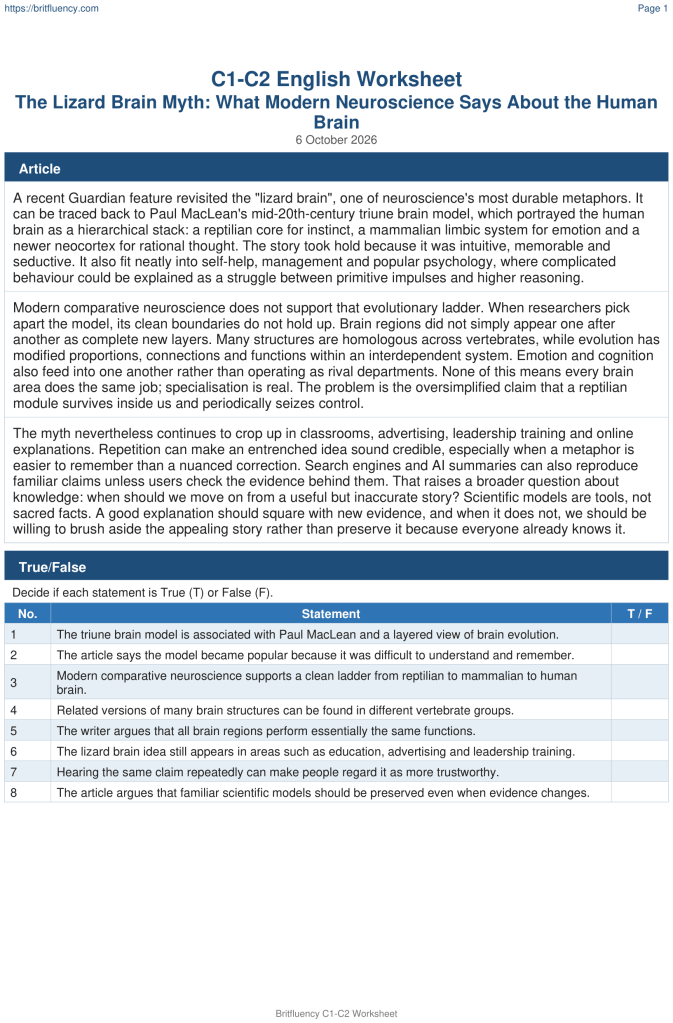
The article traces the “lizard brain” idea back to Paul MacLean’s mid-20th-century triune brain model. This influential theory portrayed the human brain as a hierarchical stack consisting of a reptilian core for instinct, a mammalian limbic system for emotion and a newer neocortex for rational thought.
Students then examine why modern neuroscience does not support this clean evolutionary ladder. Brain structures did not simply appear as complete new layers, and many structures are homologous across vertebrate groups. Evolution has instead modified proportions, connections and functions within an interdependent system.
The worksheet also challenges the idea that emotion and cognition operate as rival departments. Specialisation within the brain is real, but the oversimplified claim that a primitive reptilian module periodically seizes control does not hold up under modern evidence.
Students also explore why inaccurate scientific stories can become entrenched. Memorable metaphors may fit neatly into self-help, management, advertising and online explanations, while search engines and AI summaries can reproduce familiar claims if users do not check the evidence behind them.
The lesson therefore raises a broader question about scientific knowledge: when should people move on from a useful but inaccurate model? Students consider whether familiarity and popularity influence credibility, how schools should update scientific explanations, and what standards an idea should meet before it is taught or used to make decisions.
The PDF includes a C1–C2 reading article, True / False questions, Phrase Match, Synonym Match, a task where students use new language, discussion questions and a full answer key.
Level: C1–C2
Date: 6 October 2026
Focus: advanced reading, vocabulary, neuroscience, scientific models, evidence, misinformation and speaking
This free worksheet includes:
- a C1–C2 reading article about the “lizard brain” myth
- discussion of Paul MacLean’s triune brain model
- explanation of why modern neuroscience rejects a simple evolutionary ladder
- discussion of homologous brain structures and interdependent systems
- True / False comprehension questions
- Phrase Match practice with advanced expressions
- Synonym Match with high-level vocabulary
- a sentence-writing task using new language
- discussion questions for Student A and Student B
- full answer key
The worksheet includes useful advanced phrases such as can be traced back to, took hold, fit neatly into, pick apart, hold up, feed into, crop up, move on from, square with and brush aside. It also practises vocabulary such as durable, hierarchical, intuitive, seductive, homologous, interdependent, oversimplified, entrenched, credible and nuanced.tly.emature, deliberate, tolerance, uncertainty, unresolved and magnify.
Worksheet preview
More free English resources from Britfluency:
B2–C2 English Worksheets
A2–B2 English Worksheets
IELTS Practice Materials
Free English Grammar Worksheets PDF
