Level: IELTS Academic Writing Task 1
Task type: Bar chart
Recommended time: 20 minutes
Word count: At least 150 words
Task
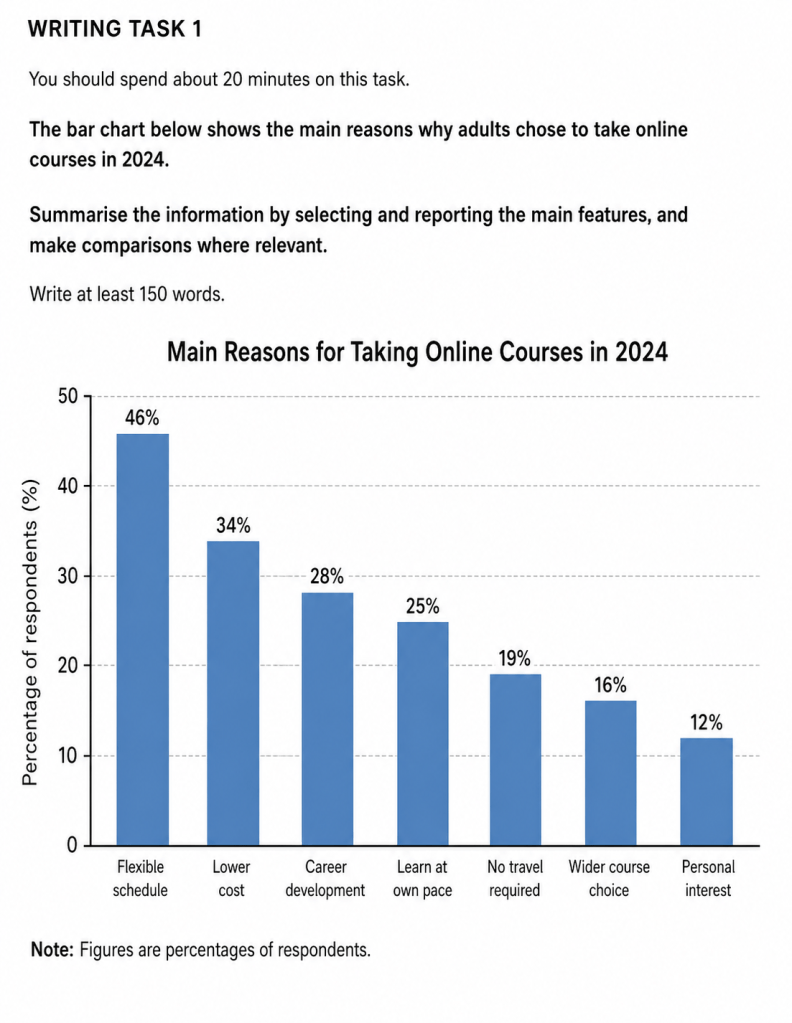
The bar chart below shows the main reasons why adults chose to take online courses in 2024.
Summarise the information by selecting and reporting the main features, and make comparisons where relevant.
Write at least 150 words.
How to approach this task
Start with a short introduction that paraphrases the question.
Then write a clear overview. For this bar chart, the most important overall point is that flexible scheduling was the most common reason for taking online courses, while personal interest was the least common. The chart also shows that practical reasons, such as flexibility, cost and career development, were more popular than personal or convenience-based reasons.
After that, describe the highest figures first. Mention that flexible schedule was the leading reason, followed by lower cost and career development.
Then describe the lower figures. Explain that learning at one’s own pace was slightly less common than career development, while no travel required, wider course choice and personal interest were the least frequently selected reasons.
Use comparison language. Do not simply list all the bars one by one. A stronger answer should group the reasons logically and highlight the biggest differences.
Do not give opinions. Do not explain why adults chose online courses. Do not add information that is not shown in the chart.
Useful language
Introducing the chart
The bar chart shows…
The chart compares…
The data presents the main reasons why…
The figures are given as percentages of respondents.
Writing an overview
Overall, flexible scheduling was the most common reason.
Overall, practical reasons were more popular than personal interest.
Personal interest was the least common reason.
The highest figure was for flexible schedule, while the lowest was for personal interest.
Describing percentages
accounted for
represented
was selected by
was chosen by
stood at
made up
the proportion of respondents who chose…
the figure for…
Useful comparison language
by far the most common reason
considerably higher than
slightly higher than
almost twice as high as
less than half the figure for
followed by
in comparison
by contrast
Useful grammar
Flexible schedule was chosen by 46% of respondents.
Lower cost was the second most common reason, at 34%.
Career development accounted for 28%, compared with 25% for learning at one’s own pace.
Personal interest was the least common reason, at only 12%.
The figure for flexible schedule was almost four times as high as the figure for personal interest.
Practice task
Write your own answer in at least 150 words. Try to include:
a clear introduction
a clear overview
the highest and lowest reasons
accurate percentages
clear comparisons between categories
grouped information
no personal opinion
no invented details
What a strong answer should do
A strong IELTS Task 1 response to this bar chart should:
- Give a clear overview of the main pattern.
- Identify the highest and lowest categories.
- Group similar figures together instead of listing every bar separately.
- Use accurate percentages from the chart.
- Make clear comparisons between the reasons.
- Avoid explaining reasons that are not shown in the chart.
Example answers
Target Band 6.5 model answer
The bar chart shows the main reasons why adults chose to take online courses in 2024. The figures are given as percentages of respondents.
Overall, flexible scheduling was the most common reason, while personal interest was the least common. Practical reasons, such as flexibility, lower cost and career development, were chosen by more respondents than the other categories.
Flexible schedule was selected by 46% of adults, making it the highest figure on the chart. Lower cost was the second most common reason, at 34%. Career development was also an important factor, accounting for 28% of respondents.
The remaining reasons were less popular. Learning at one’s own pace was chosen by 25% of adults, which was slightly lower than the figure for career development. No travel required accounted for 19%, while wider course choice was selected by 16%. The lowest figure was for personal interest, at only 12%. This was much lower than the percentage for flexible schedule.
Why this is around a target Band 6.5
This answer covers the task clearly and includes a relevant overview. It identifies the highest and lowest categories, uses accurate percentages and organises the information logically.
However, the language is fairly straightforward. Some phrases, such as was chosen by, was selected by and accounted for, are repeated. The comparisons are clear but not especially flexible or developed. This makes it suitable as a Target Band 6.5 model.
Target Band 8.0 model answer
The bar chart compares the main reasons why adults decided to take online courses in 2024, with figures shown as percentages of respondents.
Overall, flexibility was the dominant motivation, while personal interest was the least frequently selected reason. The chart also indicates that practical considerations, particularly schedule, cost and career development, were more influential than factors related to convenience or personal preference.
Flexible schedule was by far the leading reason, chosen by 46% of respondents. This was 12 percentage points higher than lower cost, which ranked second at 34%. Career development was the third most common reason, at 28%, slightly ahead of learning at one’s own pace, which accounted for 25%.
The remaining categories attracted noticeably smaller proportions. No travel required was selected by 19% of adults, while wider course choice stood at 16%. Personal interest was the least common reason, at just 12%. Notably, the figure for flexible schedule was almost four times as high as the figure for personal interest, showing a clear preference for practical benefits over purely personal motivation.
Why this is around a target Band 8.0
This answer gives a strong overview and clearly highlights the main pattern in the chart. It does not simply list the bars; it groups the reasons into broader categories and compares them effectively.
The vocabulary is more flexible, with phrases such as dominant motivation, practical considerations, more influential than, ranked second, attracted noticeably smaller proportions, and purely personal motivation. The grammar is controlled, and the response uses a range of comparative structures without adding information that is not shown in the chart.
Rubric note for students
In the real IELTS exam, your final score is not decided only by word count or advanced vocabulary. IELTS Writing Task 1 is assessed through four areas:
Task Achievement – Did you cover the task properly and highlight the key features?
Coherence and Cohesion – Is your answer clear, logically organised and well linked?
Lexical Resource – Is your vocabulary accurate and varied enough?
Grammatical Range and Accuracy – Do you use a range of sentence structures accurately?
For Task 1, write at least 150 words, spend about 20 minutes, and write in connected paragraphs, not notes or bullet points.
Quick writing tips
Always include an overview.
Do not list every bar mechanically.
Mention the highest figure: flexible schedule, 46%.
Mention the lowest figure: personal interest, 12%.
Group the middle figures logically.
Use exact percentages where useful.
Do not explain why adults chose these reasons.
Keep the answer factual and neutral.
