Level: IELTS Academic Writing Task 1
Task type: Natural process diagram
Recommended time: 20 minutes
Word count: At least 150 words
Task
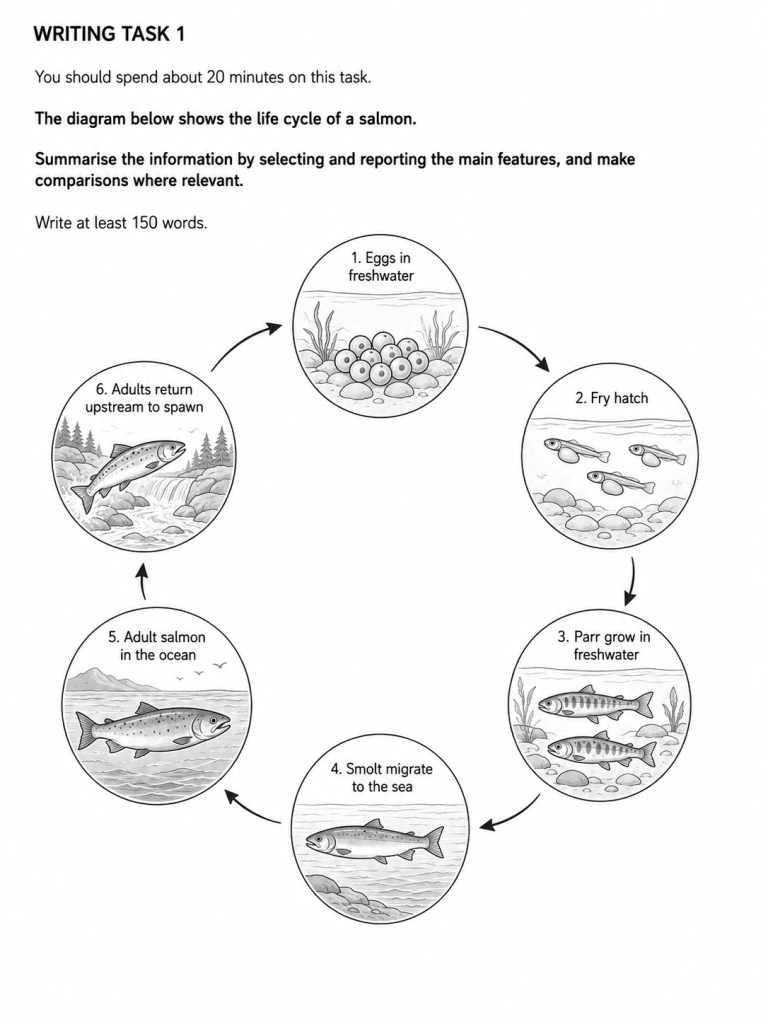
The diagram below shows the life cycle of a salmon.
Summarise the information by selecting and reporting the main features, and make comparisons where relevant.
Write at least 150 words.
How to approach this task
Start with a short introduction that paraphrases the question.
Then write a clear overview. For this task, the most important overall point is that the salmon life cycle is cyclical. It begins with eggs in freshwater, moves through several growth stages, includes migration to the sea, and ends when mature fish return upstream to spawn and begin the cycle again.
After that, describe the stages in order. A simple and effective structure is:
Paragraph 1: eggs, fry and parr in freshwater
Paragraph 2: smolt migration, adult salmon in the ocean, and the return upstream to spawn
Try to highlight the broad pattern rather than just listing labels. For example, you can point out that the early stages take place in freshwater, while the adult growth stage happens in the sea.
Do not invent extra facts. Do not explain the biology in detail. Only describe what is shown in the diagram.
Useful language
Introducing the diagram
The diagram illustrates…
The diagram shows…
The process begins with…
The life cycle starts when…
Writing an overview
Overall, this is a cyclical natural process.
Overall, salmon pass through six main stages.
Broadly, the early stages occur in freshwater, while the fish later migrate to the sea.
The cycle is completed when adult salmon return upstream to spawn.
Sequencing language
initially
at the first stage
next
after this
subsequently
once this has happened
in the following stage
finally
Useful process verbs
are laid
hatch
grow
develop into
migrate
mature
return upstream
spawn
Useful comparison language
whereas
while
in contrast
compared with
unlike the earlier stages
the first three stages occur in freshwater, while…
the adult stage takes place in the sea, whereas…
Practice task
Write your own answer in at least 150 words. Try to include:
a clear introduction
a clear overview
the stages in the correct order
accurate sequencing language
at least one relevant comparison
no personal opinion
no invented details
What a strong answer should do
A strong IELTS Task 1 response to this diagram should:
- Cover the main stages clearly.
- Give a relevant overview rather than only listing details.
- Organise the information logically.
- Use suitable vocabulary for life-cycle and process descriptions.
- Show a range of sentence structures with good grammatical control.
Example answers
Target Band 6.5 model answer
The diagram shows the life cycle of a salmon.
Overall, this is a cyclical process with six main stages, beginning with eggs in freshwater and ending when adult salmon return upstream to spawn. It is also noticeable that the early stages happen in freshwater, while the fish later migrate to the sea before coming back.
At the first stage, salmon eggs are laid in freshwater. These eggs then hatch and become fry. After this, the young fish grow further and develop into parr, which continue living in freshwater.
In the next stage, the parr become smolt and migrate to the sea. Once in the ocean, they grow into adult salmon. In the final stage, the mature fish swim back upstream in order to spawn. This produces a new group of eggs in freshwater, and the cycle begins again.
Why this is around a target Band 6.5
This answer covers all the main stages, includes a clear overview, and is easy to follow. It uses accurate process language and enough information from the diagram without adding extra details.
However, the language is fairly straightforward. The sentence structures are clear but not especially varied, and the comparison between freshwater and sea stages is simple. This makes it suitable as a Target Band 6.5 model.
Target Band 8.0 model answer
The diagram illustrates the life cycle of a salmon, showing how the species develops from eggs to adulthood before reproducing and restarting the cycle.
Overall, the process is cyclical and consists of six main stages. It begins when eggs are laid in freshwater and continues through several stages of growth before the fish migrate to the sea. The cycle is completed when fully mature salmon return upstream to spawn. A notable feature is that the juvenile stages occur in freshwater, whereas the adult growth stage takes place in the ocean.
Initially, eggs are deposited in freshwater. These hatch into fry, which then continue developing into parr while remaining in the same environment. The next stage occurs when the parr grow into smolt, at which point they migrate from freshwater to the sea.
Once in the ocean, the fish mature into adult salmon. In the final stage, these adults swim back upstream to spawn in freshwater. This leads to the production of a new generation of eggs, thereby beginning the life cycle again.
Why this is around a target Band 8.0
This version gives a strong overview, selects the key features clearly, and groups the information logically. It does not simply list the six stages; it highlights the broader pattern of development from freshwater to sea and back to freshwater.
It also uses more flexible vocabulary, such as cyclical, juvenile stages, mature, deposited, and thereby. The grammar is controlled, and the response uses varied sentence structures without adding information that is not shown in the diagram.
Rubric note for students
In the real IELTS exam, your final score is not decided by word count alone or by using advanced vocabulary. IELTS Writing Task 1 is assessed through four areas:
Task Achievement – Did you cover the task properly and highlight the key features?
Coherence and Cohesion – Is your answer clear, logically organised and well linked?
Lexical Resource – Is your vocabulary accurate and varied enough?
Grammatical Range and Accuracy – Did you use a range of sentence structures accurately?
For Task 1, write at least 150 words, spend about 20 minutes, and write in connected paragraphs, not notes or bullet points.
Quick writing tips
Always include an overview.
Do not copy the labels word for word too much.
Group the stages logically rather than describing each one separately.
Mention the freshwater stages and the sea stage clearly.
Do not add outside knowledge about salmon.
Keep the answer factual and neutral.
